
The single-diode model has been the industry standard for simulating solar module and cell performance. Historically, it has provided reasonable accuracy across various operating temperatures and irradiance levels. However, the rapid evolution of solar technology, especially with the development of higher-efficiency modules, is pushing this model to its limits.
Emerging technologies like n-TOPCon and heterojunction (HJT) are set to surpass PERC technology, with cell efficiencies expected to exceed 26% in the coming years. A key characteristic of these advanced cells is their exceptionally low carrier recombination, both in the silicon bulk and at the surfaces or contacts. This reduction in recombination loss significantly enhances the fill factor, making the single-diode model’s limitations more pronounced.
The single-diode model struggles to accurately represent the interplay between “standard” recombination and intrinsic recombination in these ultra-high-efficiency cells. This study explores how well the single-diode model can describe these advanced cells and suggests improvements by adjusting the fitting process to account for intrinsic recombination effects.
Process Undertaken
The study utilized simulated data from Quokka3, a sophisticated 3D device solver. We modeled the current world record cell, which boasts a 26.81% conversion efficiency under standard test conditions (STC). The simulations covered a range of illumination intensities from 100 to 1100 W/m² and temperatures between 15°C and 50°C. We performed both standard and adjusted single-diode fitting on this data.
For intrinsic adjustment, we used current expressions for Auger and radiative recombination. Recombination currents for each process were calculated for varying temperatures and voltages and added to the measured current at each point. This adjusted curve was then fitted using the standard single-diode equation to improve accuracy.
Key Learnings
The study revealed that with the correct parameter selection, the “standard” single-diode model, as implemented in PVSyst, can accurately track the maximum power’s dependence on illumination and temperature. However, this accuracy comes at the cost of the rest of the I-V curve, particularly the open-circuit voltage, which the model fails to predict accurately.
In contrast, our adjusted model provided a precise fit for the entire I-V curve under all potential operating conditions. Figure 9 demonstrates the root-mean-square-error values for both the standard single-diode model (left) when accurately predicting maximum power and our adjusted model (right), showing a significant improvement in overall prediction accuracy.
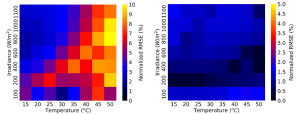
Figure 9: Graph showing the comparative root-mean-square-error values for the standard single-diode model versus the adjusted model.
Transferability
The challenges of modeling high-efficiency modules are well-recognized within the simulation industry. This work offers a pathway for addressing these challenges, suggesting that the adjusted model could be incorporated into existing software packages. However, this integration will necessitate the development of new measurement standards and techniques.
Another potential avenue is using this adjusted model to guide the development of a simplified approximation for situations where the highest accuracy isn’t critical. This approach would allow for better representation of advanced solar cells without requiring extensive changes to existing simulation tools.
Implications for Future Projects
This research is crucial for future developments, especially for our partners at LONGi and SunDrive. As we continue to refine the model to represent the highest-efficiency solar cells ever created, we will extend its application to module and system levels, benchmarking it against field data from our partners.
A key area of focus will be integrating these cell models with SunSolve’s cell-level ray-tracing technology. This integration promises unprecedented simulation accuracy for modules using these advanced cells and will enable precise predictions of module performance based on cell production data.
In summary, while the single-diode model has served the industry well, the rise of ultra-high-efficiency solar cells necessitates an evolution in our modeling approach. By adjusting the fitting process to account for intrinsic recombination, we can enhance our predictive capabilities, enabling more accurate simulations and better decision-making in the rapidly advancing solar industry.
Written by Dr. Phil Hamer