
In recent years, the global integration of renewable energy has surged, driven by efforts to reduce carbon emissions. A significant part of this growth has been in solar photovoltaic (PV) technology, which is projected to become one of the leading sources of renewable energy worldwide by 2030. Recently, Australia has announced its multibillion-dollar SunShot Programme, to accelerate manufacturing, deployment, and grid integration of solar technologies. One of the major goals of this programme is to facilitate Australian-manufactured solar panels for setting up large-scale solar PV farms globally.
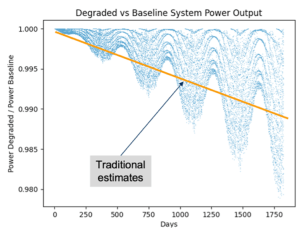
Most of the module manufacturers provide a lifetime warranty of 20-25 years, considering a linear degradation rate of ~0.5%/year globally. These degradation rates of these modules are often calculated considering indoor testing conditions for specific locations. However, when the modules are exposed to outdoor conditions they endure diverse environmental conditions like extreme heat, snow, rain, wind, etc. depending on their installation site. Therefore, regional climate plays an important role in determining the longevity and reliability of the modules.
One of the biggest challenges in the solar industry is simulating climate specific degradation rates accounting for the various climate stresses that can initiate pre-mature aging of the modules. Furthermore, there is a huge challenge in translating the lab experiments used to quantify degradation into field-based simulations. Till date, most of the work done in the industry accounts for a linear module degradation without considering the influence of regional climate.
Crystalline silicon PV modules are the most dominant technology globally and get easily impacted by the UV radiation, temperature and humidity. Encapsulant discoloration, caused due to over exposure to UV radiation is one of widely experienced degradation mode in these type of PV modules. Traditionally, discoloration has been quantified as yellowness index obtained using the spectrophotometric tests prior and post deployment periods. However, there is evidence that discoloration rates can hugely vary from the UV dosage along with the moisture at the surface of the modules. Presence of moisture on the module surface can also damage the edge sealant and thereby leading to penetration of moisture in the modules. This also increases the electrical conductivity of the material, causing performance loss. The modules are extremely sensitive to high temperature. Higher module temperatures can lead to reduction in efficiency of the solar panel along with additional defects like hot spots, snail-trails, cracks, etc.
We adapt physics-based approach to understand the first principle of the module degradations and combine it with the regional climate to gain an understanding of the weather parameters that can initiate module failure. Our framework considers non-linear interactions among the weather parameters and temporal variations in the module degradations. This is shown in the figure 1 above. The non-linear degradation of the module over time due to its dependence on the weather as opposed to the traditional estimates. In the past, the degradation rates have been considered as linear as shown in the orange line.
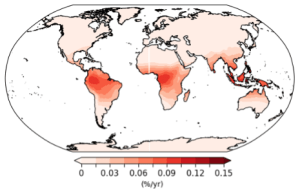
Figure 2. Average photo-degradation rate of crystalline-silicon modules for 1980-2020.
For example, the influence of humidity and UV radiation has been simulated to quantify photo-degradation globally (figure 2). The regions with high UV and humidity have moderate to high degradation rates. With our advanced modelling approach, we can estimate the regions more likely to be susceptible to a specific degradation mode and provide solutions to the solar farm operators and manufacturers to improve the module lifetime.
Written by Dr. Shukla Poddar